
The Dust Gets On You

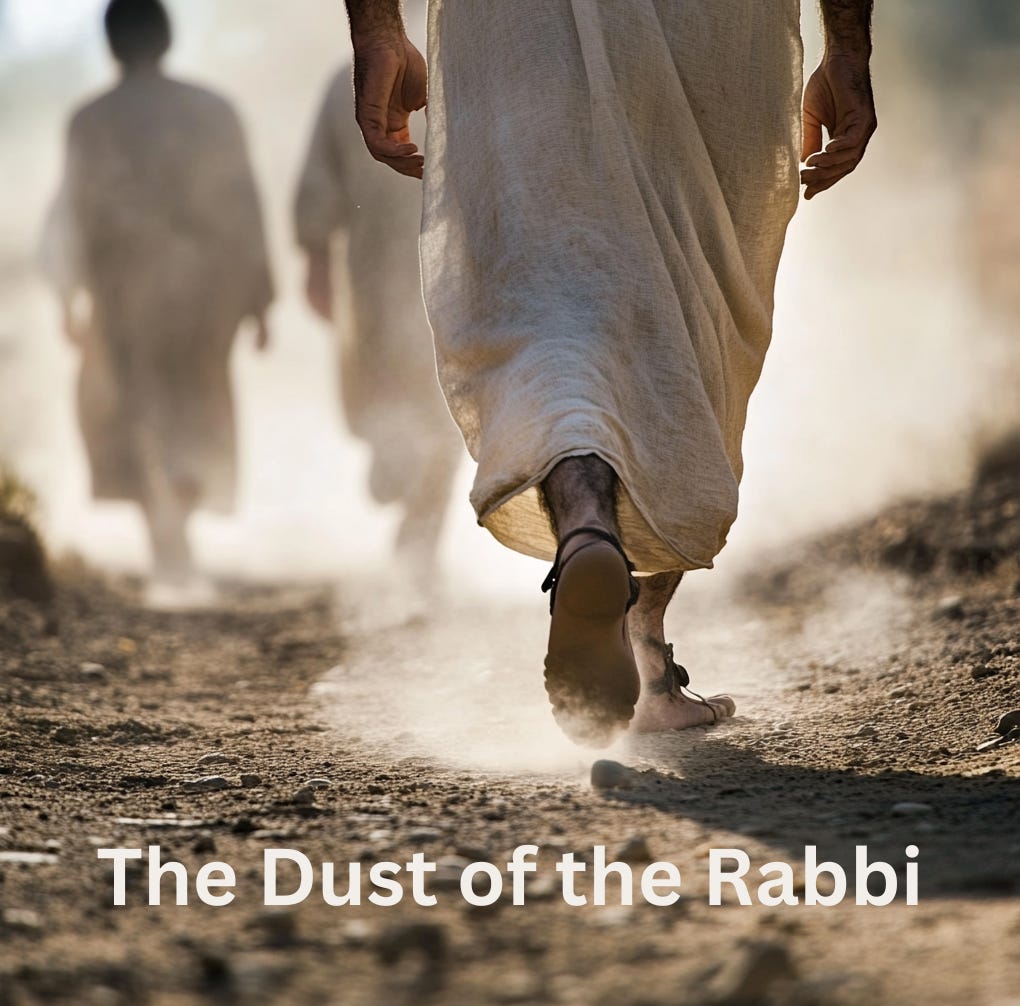
MONDAY’S COMPASS: | The Dust of the Rabbi, March 16
If you enjoy these reflections, consider sharing this post with someone who needs it. And if you’d like to go deeper, paid subscribers receive a monthly practice tool, teaching video, and live Zoom conversation — all designed to take your formation further. You can upgrade anytime below.
There is an old rabbinical saying that has stayed with me for several years.
When a young student began to follow a rabbi in the first century, he did not simply enroll in a school. He attached himself to the man. He watched how the rabbi walked, how he prayed, how he handled a difficult question or an ordinary meal. He followed so closely, so literally, that the dust the rabbi kicked up on the road settled on the student’s own clothing.
May you be covered in the dust of your rabbi.
That was the blessing. That was the goal.
I have been thinking about that image while walking with Jesus through Luke’s long account of the road to Jerusalem that begins in Luke 9:51 and ends in Luke 19. Ten chapters. The longest journey in any of the Gospels. And the dust on that road, I am beginning to understand, is not the easy kind.
Luke tells us that at the beginning of this journey, Jesus “set his face to go up to Jerusalem.” The Greek is unambiguous — this is not the language of someone carried along by events. It is the language of a man who has looked clearly at what lies ahead and locked into the journey with everything in him.
The roads to Jerusalem were full. Passover was coming, which meant the ancient pilgrimage had begun. Families from Galilee, from the Decapolis, from distant corners of the diaspora — all of them moving toward the holy city, drawn by the same rhythms that had pulled Jewish feet toward Jerusalem for a thousand years. It was the great homecoming. The feast of liberation. The yearly remembrance that God had once led his people out of darkness into freedom.
Jesus of Nazareth was on that road too.
But he was not going to Jerusalem for Passover. He was going to Jerusalem to become it.
What lies ahead, he already knows. Somewhere near the end of the journey he draws his closest friends together and tells them quietly: “We are going up to Jerusalem, and everything that is written by the prophets about the Son of Man will be fulfilled. He will be delivered over to the Gentiles. They will mock him, insult him and spit on him; they will flog him and kill him” (Luke 18:31).
He named them. Each indignity. One by one. Not as a warning. Not with self-pity. Simply as a man reading waypoints off a map he has been carrying for a long time.
And then the writer of Hebrews steps back and surveys the whole of it — this road, this cross, this man — and offers us this: Jesus, “for the joy set before him, endured the cross, scorning its shame” (Hebrews 12:2).
I keep returning to that phrase. Scorning its shame. Not immune to it. Not unaware of it. But holding something deeper than the shame that made the shame — somehow — unable to have the final word.
What was he holding?
I am not sure I fully know. But I find myself wanting to get close enough to find out.
So did Paul.
From a prison cell, having already survived shipwrecks and beatings and a sufficiency of human betrayal, Paul wrote what I consider one of the most luminous and bewildering sentences in all of Scripture.
He said, “All things are worth nothing compared with the superior value of knowing Christ Jesus…” (Philippians 3:8).
Everyone in the room who is into spiritual formation cheers. Of course they do. To know him. Yes. A thousand times yes.
And then Paul kept writing.
“I want to know Christ — yes, to know the power of his resurrection—”
Hands go up. Deep-throated amens bounce off the walls. This is the part we came for. Who wouldn’t want that — even a skeptic can feel the pull of it.
“—and participation in his sufferings, becoming like him in his death.”
And the room goes quiet.
Not politely quiet. That particular kind of quiet that falls when something true has been said and nobody quite knows what to do with it. The amens dry up. The hands come down. We look at each other sideways.
Who wants that?
Nobody, if we’re honest. Not the suffering part. Not the becoming-like-him-in-his-death part. We want the resurrection. We want the power. We would like, if it is at all possible, to have the Easter without the Friday.
But Paul had gotten enough dust from the road on him to know those two things could not be separated. He had learned — the hard way, the only way — that the road into suffering is not a detour away from Christ. It is, mysteriously, one of the roads that leads most directly toward him.
This is not the faith being sold in certain quarters today. The version that tells you Jesus is a guarantee against difficulty, that faith is a hack for arriving at a better version of the life you already wanted.
I sat in a van with church leaders in Nigeria once on the way to an event. A woman in the seat in front of me turned and asked me a question.
“Do you want to know the difference between Christians in America and Christians in Nigeria?”
She was going to tell me regardless, so I nodded.
“You Americans think comfort is a sign of God’s blessing,” he said. “We think suffering is a sign of God’s blessing.”
She said it quietly. She wasn’t angry. She wasn’t performing. She had simply been on the road long enough to know something that the prosperity rewrite of Christian faith — a rewrite, I should say, that most Christians in our world would not recognize — has quietly edited out.
The dust gets on you. That is not a tragedy. That is the point.
Every Good Friday, Lorri and I read a poem together. We have done it for years now, and it still does its work on us every time. It was written by Amy Carmichael — Irish missionary, mother to hundreds of children in India, a woman who spent the last twenty years of her life confined to a bed after a fall and who, by every account, never lost the thread. She knew what it meant to follow closely. She knew what the dust felt like.
She wrote:
Hast thou no scar? No hidden scar on foot, or side, or hand? I hear thee sung as mighty in the land, I hear them hail thy bright, ascendant star, Hast thou no scar?
Hast thou no wound? Yet I was wounded by the archers, spent, Leaned Me against a tree to die; and rent By ravening beasts that compassed Me, I swooned: Hast thou no wound?
No wound? No scar? Yet, as the Master shall the servant be, And pierced are the feet that follow Me; But thine are whole: can he have followed far Who has no wound nor scar?
That line has been doing its work on me for a long time.
I hear thee sung as mighty in the land.
If one line in all of literature comes close to describing a chapter of my own journey, it may be that one. I came to faith hungry — hungry in the way that a person is hungry when the wounds run deep and the need for validation runs deeper. And the church, God help it, is very good at providing the things that feel like validation. I became pastor of one of the largest churches in Canada. I earned a doctorate from Princeton Theological Seminary. I collected, without fully realizing I was collecting, the props that hold up a person who still needs to be sung as mighty in the land.
They were not nothing, those things. I am glad for them. The experiences were real. The learning was deep. The people were real.
But they were props. And props, however impressive, are not the same as an identity. And for a long while they got between me and the one who had asked me to follow him closely. It is hard to get his dust on you when you are busy building your platform.
The long journey of my life — and it has been long, and it has often been crooked — has been the slow work of setting those things down. Not bitterly. Not with regret. But with the dawning recognition that what I had been treasuring was keeping me at a careful distance from the road I actually wanted to walk.
Carmichael knew something about that road. She spent twenty years in a bed, stripped of everything but the thing itself. And from that bed she wrote more than most of us will write in a lifetime of standing up.
The dust gets on you. But first, sometimes, you have to put down what you have been carrying in both hands.
I want to sit with Carmichael’s last question rather than answer it.
Can he have followed far who has no wound nor scar?
Not as an accusation. As a genuine wondering. As the kind of question that, if you let it, quietly reorients everything.
I wonder sometimes what it costs those of us in the comfortable parts of the world to follow closely enough to get his dust on us. Not because suffering is the goal — it isn’t. Not because hardship is something to be sought — it isn’t. But because somewhere in the long, well-managed project of keeping our lives safe and predictable and undisturbed, we may have also kept our distance from the one who set his face toward Jerusalem.
And the strange, tender, utterly unmanageable thing about that man is this: he is not asking us to understand the road before we walk it. He is asking us to walk it with him. To follow closely enough that when he moves toward the hard thing, we are near enough to feel it too.
Paul wanted that. Carmichael wanted that. A long procession of men and women across the centuries who got dust on their sandals and found, in the finding, something they could never have located from a safe distance — they wanted that.
Jesus asked the Twelve to walk to Jerusalem with him, even though they did not understand what they were walking toward.
He is asking us the same thing.
May you be covered in the dust of your rabbi.
On the wall of my office there is a photograph of a road stretching off into the far distance. Beneath it, a line from Dag Hammarskjöld:
“How long the road is. But how I’ve needed every mile it has passed by.”
Thanks for reading The Compass. If this found you at the right moment, consider passing it along — someone you know may need it today.