
A Place to Stand
Nobody decides one morning to stop following Jesus. A post about the slow displacement, and the embarrassingly simple way back.

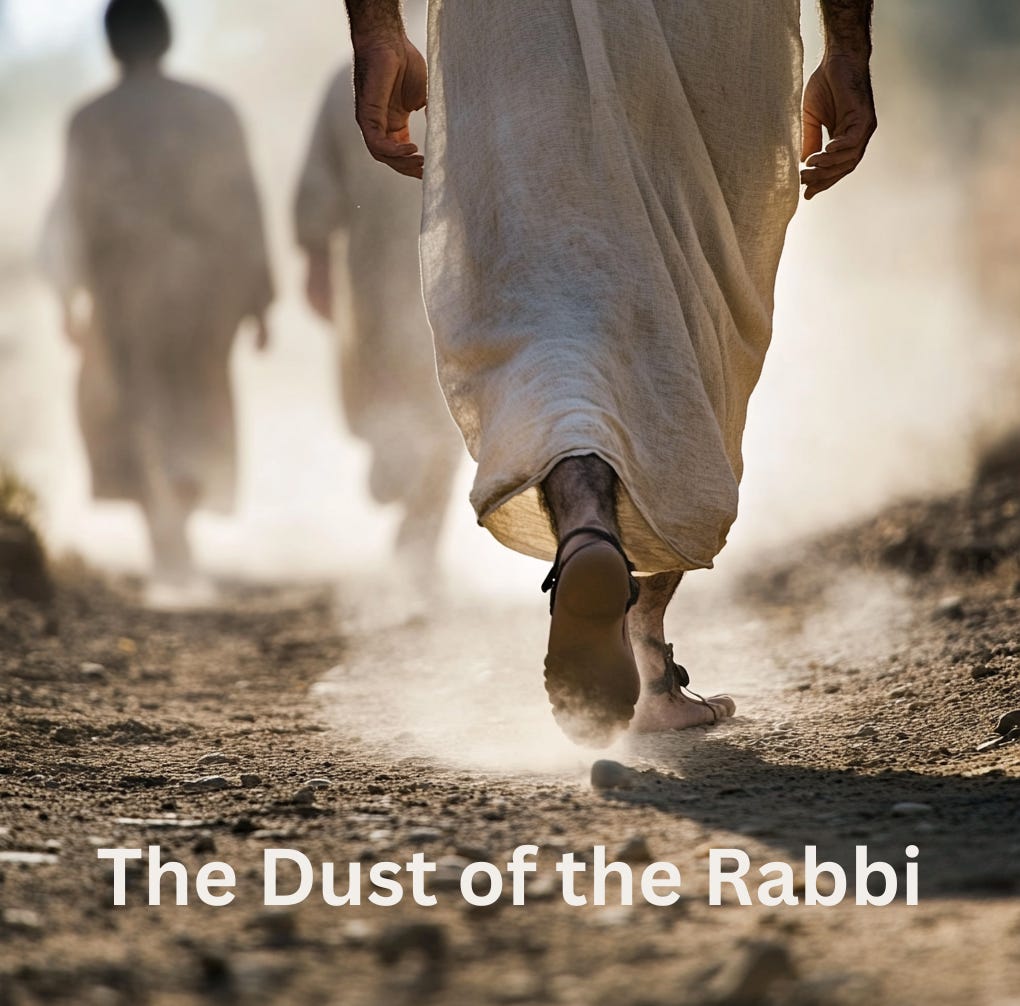
Monday’s Compass | THE DUST OF THE RABBI | June 8, 2026
For new readers: The Compass is a newsletter on spiritual formation, and “The Dust of the Rabbi“ is one of its recurring series. In the ancient world, a rabbi’s most devoted students followed so closely behind him that the dust of his walking settled on them. They wore it as a badge of belonging. This Monday series draws attention to Jesus. The Monday articles are written to express my love for Jesus and they hold a hope: that you will be drawn into deeper communion with Jesus.
Elton Trueblood never grew tired of the story of Archimedes.
He told it in classrooms. He told it at dinner tables. He told it to me so many times in his library I can still hear the chuckle and the way his voice dropped a register when he got to the good part.
The story goes like this. Archimedes had discovered the lever, and in an age when brute force was the only mechanism most people knew for moving heavy things, he was pulling off feats that looked like magic. Crowds gathered. Mouths dropped open. Finally a king summoned him and asked the question that had been forming on everyone’s lips: how much weight can you lift?
Archimedes didn’t answer the way they expected. He pointed past himself.
“Give me a place to stand, and I will lift the earth.”
The right fulcrum. The right foundation. Given those two things, the amount of weight a simple lever can move becomes almost incomprehensible.
Trueblood loved that story because he believed it was, in a very deep sense, the story of Jesus.
Most of us know what it feels like to lose the thread.
Not in any dramatic way. Nobody wakes up and decides the thing that mattered most doesn’t matter anymore. It’s quieter than that. Life fills in around it. The kids need driving somewhere. The second job starts. The inbox gets ahead of you and stays there. For the person in ministry it might be the next sermon, the next crisis, the next budget meeting. But the shape of it is the same for almost everyone: the days get full of real things, necessary things, and the one thing that started everything slowly moves to the edges without anyone deciding it should.
I’ve watched it happen in the people who come to Stillpoint exhausted and not quite sure why. I’ve heard it surface in spiritual direction conversations, in the pauses where someone is finally telling the truth. And I’ve found it in myself on the trail, when the noise stops and there’s nothing left to hide behind.
The regret, when it comes, isn’t loud. It’s more like a quiet recognition. Something essential got crowded out. And I’m not pointing at anyone I haven’t already found in the mirror.
We have never been short of people telling us what will finally fix things. There are lots of claims that that this lever, or that one, will lift the weights that keep us down.
Every generation gets its version of the promise. Work hard enough and the life you want is within reach. Align yourself with the right politics and justice will follow. Buy the right things, live in the right neighborhood, raise your children the right way, and security is yours. We absorb these promises so early and so thoroughly that most of us don’t even hear them as promises anymore. They just feel like the shape of how things work.
And then there are the larger, more deliberate versions. Marx said the lever is class consciousness. Plant it under the structure of history and the whole weight of human suffering can finally be moved. Mao said the same thing with different language. Antonio Gramsci, whose ideas have quietly reshaped more of our current moment than most people realize, said the lever is cultural power. Capture the schools and the churches. Control what a society is permitted to think and say. Do that, and you can lift anything.
Every revolution has its fulcrum and its promise. Every ideology says: this is the thing that moves the world.
And none of them are revolutionary enough. Not finally. Not all the way down.
Because every one of them, pressed far enough, ends up deciding that some people matter while some are expendable. The lever that was supposed to free everyone ends up crushing whoever gets in the way.
That is not a political observation. It is a theological one.
Jesus announced something that none of these can match, and he announced it without hedging.
Every human being is an object of God’s unconditional concern. Not contingent. Not conditional. Not scaled to your usefulness or your agreement with the current consensus or your standing with whoever is doing the sorting. Every person. Unconditional.
That is the fulcrum. Jesus and his way is the place to stand.
When you actually place the lever there, things move that looked immovable. Racism cannot survive it. Not real racism, not the kind that assigns worth by bloodline or skin or origin. It cannot survive the announcement that every person is God’s beloved, full stop. Injustice cannot survive it either, because injustice always depends on someone’s life mattering less than someone else’s. The ideological machinery that tells people what they are allowed to think and say, that rewards conformity and punishes honest inquiry, that makes entire categories of human beings into problems to be managed rather than persons to be loved cannot survives contact with what Jesus actually said.
Celebrity Christianity doesn’t survive it either. The version of church that is really a platform, that orbits a leader’s brand, that measures faithfulness by the metrics of influence and reach. Jesus has no patience for any arrangement that puts a human being at the center.
He is not a new fulcrum among many. He is the one that works. He is the one that doesn’t eventually crush the people underneath.
I keep coming back to this on the trail. Moving through the mountains, through air that doesn’t care about your reputation or your output, has a way of returning you to honest ground.
The honest ground, for me, is this: There have been times when the lever for me was planted close to Jesus, but not on Jesus. It was planted on the thing I was doing for Jesus. Adjacent. Close. Sometimes really good things. But here’s the thing: the lever has to rest on the right fulcrum or the weight doesn’t move. It just grinds you down slowly until one day you look up and realize you’ve been exhausted for years and can’t quite explain why.
The way back, every time I’ve found it, is embarrassingly simple. Lift him up again. Look at him again. Let what he actually said and did and was become the thing the whole weight rests on.
Simple enough that I sometimes think it is too simple and it can’t possibly work.
It keeps working.
Gratefully,
— Gene
If this piece resonated, forward it to one person who might need it. Not yet subscribed? Join here for five posts a week on the deeper life.
If your interior life needs more than good reading, the Certificate Program in Spiritual Direction at The Compass trains people to accompany others on that journey. Cohort 3 opens June 15 and you can enroll anytime before July 1. Information at genemaynard.podia.com.
Reading this morning.
I enjoyed and even read aloud to my husband!
He is the one that works.
This provides so much peace in my heart.
Thank you